

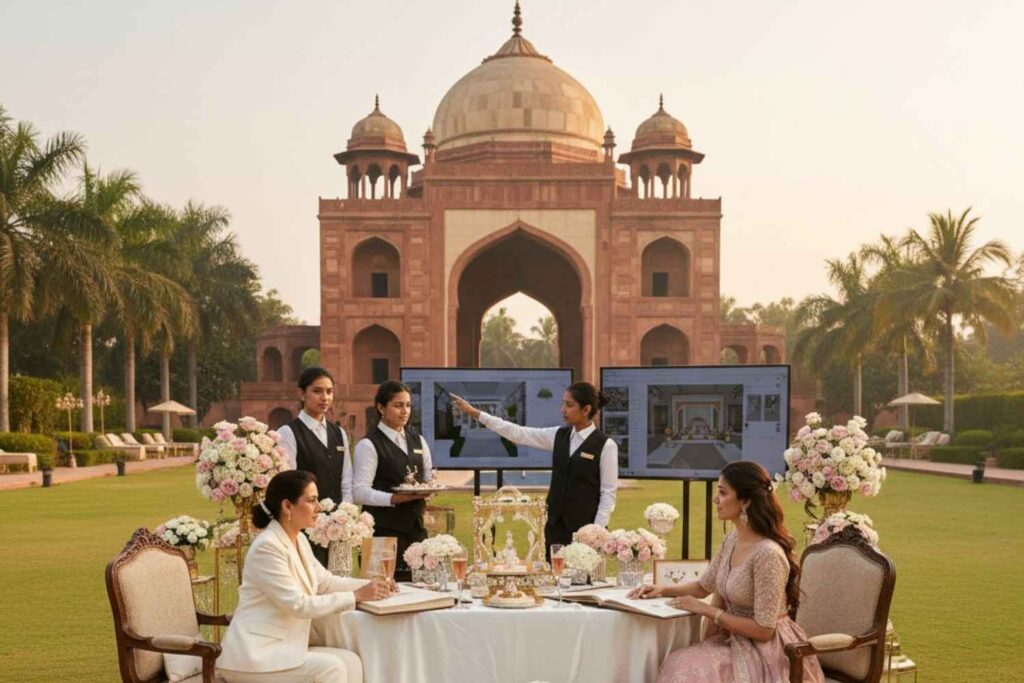
Shaurya’s call came in at 10:47 PM on a Tuesday. I know the exact time because I was about to sleep. He was literally panicking. “Dude, I’m getting married in three months and I have no idea what I’m doing.” His wedding is supposed to be spread across three different cities. Mehendi in Goa at some resort his wife’s family loves. The actual wedding ceremonies at a palace in Jaipur because that’s where his wife’s great-grandparents got married and her family is obsessed with that connection. Reception back in Gurgaon because 90% of their friends live there. His parents want the full traditional experience—mehendi, sangeet, baraat, all of it, properly done, multi-day thing. His wife’s parents want it to be modern and sleek and not too long. He’s sitting in his office in Golf Course Road trying to call vendors in Goa, negotiate with a palace in Jaipur that’s probably not going to pick up, and figure out logistics for Gurgaon. Meanwhile his mother’s sending him messages about specific rituals that have to happen. His mother-in-law’s sending him messages about guest list. He’s losing his mind. That’s when I told him, forget trying to coordinate this yourself—you need luxury wedding planners in Delhi NCR who actually know how to manage multi-city destination weddings like this. You need luxury wedding planners in Delhi NCR who understand Goa, Jaipur, and Gurgaon. You need luxury wedding planners in Delhi NCR who can juggle your family’s expectations and actually make it happen smoothly.
I told him, “Stop. Hire someone. Don’t do this yourself.” He was like, “That’s going to cost thousands.” I said, “Not hiring someone will cost you way more, trust me.” He called me back exactly 13 days later. He sounded like a completely different human. Relaxed. Actually excited about his wedding. I asked him directly, “Is the planner expensive?” He said, “Cheaper than the six mistakes I was about to make.”
Why The NCR Region Breaks People
Here’s what people don’t understand about planning a wedding in the NCR—it’s not one city. It’s like five different regions that barely talk to each other. Delhi proper has its own vendor ecosystem. Gurgaon is basically a different country with its own corporate culture and expectations. Noida’s on the other side and it’s chaotic. Faridabad’s industrial. And then you’ve got these smaller towns and heritage places all around. If your wedding touches more than one of these areas, you’re playing 4D chess.
I watched my friend Vidya try to book a venue in South Delhi for her reception. On paper it seemed perfect—nice venue, good food, affordable. She didn’t realize that getting guests from Gurgaon to South Delhi at 7 PM means they’re sitting in traffic for two hours. She didn’t think about the fact that people coming from Noida have to cross the entire city. She booked it, paid the deposit, and then realized the logistics were impossible. By the time she figured it out, it was weeks of wasted time and the deposit was non-refundable. A planner would’ve told her in the first conversation, “This venue’s going to be hell for your guest list. Here’s why. Here are better options.”
The weather thing almost destroyed my colleague’s wedding. He booked an outdoor event in Delhi in March. Seemed smart. February came and the pollution hit hard. The AQI was above 500. You literally couldn’t breathe outside. The sky was gray. Photographs looked like they were shot through a filter. He spent the entire month of February panicking and eventually moved the wedding indoors at huge cost and with tons of chaos. Someone who plans weddings all the time would’ve looked at the calendar in September and said, “March in Delhi is risky. You want outdoor? Let’s do November or early December. March we do indoor backup.”
And then there’s the international guests thing. My uncle got married and had relatives coming from the US, UK, Australia. They had no idea what to expect. One aunt showed up in heels for the mehendi thinking it was going to be like an American party. She was wearing traditional Indian clothes in her mind but showed up in an evening gown. Nobody had prepared her. Another relative didn’t understand the timeline and thought everything was happening in one day. He booked hotels for one night and had to scramble to extend his stay. Someone coordinating this should’ve sent a comprehensive guide weeks in advance explaining Indian wedding culture to people who’ve never experienced it.
The Jaipur Palace Wedding That Almost Killed My Cousin
My cousin Deepak got married in Jaipur at a heritage palace three years ago. He and his wife decided to manage it themselves to save money. I went for the wedding thinking it would be romantic and beautiful. It was a mess.
Nobody told the guests what was happening or when. Some people showed up to the mehendi in evening wear because they thought it was going to be a cocktail party. The mehendi artist was angry because nobody had explained the setup. The timing was completely off because Deepak didn’t realize that the palace had specific rules about when events could happen—noise restrictions, lighting restrictions, when gates closed. The hotel rooms he’d blocked weren’t actually confirmed properly. When guests started arriving, about 15% of them didn’t have reserved rooms and had to scramble to find hotels last minute. The caterer he booked was a local Jaipur guy who didn’t understand the timeline that Deepak wanted. Food showed up late. The lighting for the ceremonies wasn’t coordinated properly so half the photographs were badly lit. It was just… chaotic.
At the end of the wedding, I remember Deepak looking exhausted and stressed and like he hated his own wedding. His wife was upset. Their families were frustrated. It was supposed to be this beautiful destination wedding and instead it felt like a disaster that somehow got through to the end.
Fast forward to my brother-in-law Arjun’s wedding last year. Similar concept—palace in Jaipur, multiple events, destination wedding. He hired someone who does destination wedding planners in Delhi NCR. The difference was insane. Months before the wedding, guests got a PDF. It had everything. What to wear for each event. What time to show up. Where to go. Which hotel they were staying at. How transportation would work. Photos of the venues. Information about local customs. Details about the weather. Suggestions for what to bring. Everything.
When guests arrived, their rooms were confirmed and ready. Shuttles from the airport picked them up on schedule. Events started and ended on time because the planner had coordinated with the palace weeks in advance about electrical setup, noise permissions, gate times, all of it. The caterer was professional and understood the timeline. The photography was coordinated so that cultural moments were captured properly. The whole thing felt like it had been orchestrated by someone who’d done this a hundred times. Because she had.
The difference between my cousin’s wedding and my brother-in-law’s wedding was literally the difference between stress and joy. Same budget. Same type of venue. Same number of guests. One was managed by the couple. One was managed by a professional. The couple’s wedding was a nightmare. The professionally-managed one was beautiful.
What I Learned From Sitting Down With Someone Who Actually Does This
I met someone at a dinner party who works as a best destination wedding planners in Delhi NCR. I was curious about what made her job necessary, so I asked her to walk me through her actual day. We had coffee and she told me all kinds of stuff I never would’ve thought about.
She told me about a couple that wanted to get married at a specific palace in Rajasthan. The palace looked absolutely stunning in photographs. But when she went to visit it in person, she realized it had severe electrical limitations. Running proper lighting and sound required bringing in external generators. The local authorities required permits that took three months to process. The palace had strict noise restrictions so the music couldn’t be loud after 10 PM. The local catering options, while delicious, operated on completely different timelines than Delhi caterers—they needed more advance notice, worked with different equipment, had different assumptions about guest counts.
If that couple had just booked the palace themselves and showed up, they would’ve hit a dozen problems on the wedding day that would’ve been hell to solve. This planner knew all of this from the start and either worked around it or helped them find a different palace that actually worked for what they wanted.
She also told me about a couple that booked a heritage venue in Delhi. Beautiful old building. They didn’t know the building had parking restrictions. They didn’t know it had noise rules. They didn’t know about water pressure issues that would affect the catering setup. They didn’t know the building had limited electrical capacity so you couldn’t run certain equipment at the same time. A professional would’ve discovered all of this in the site visit and either solved it or recommended a different venue.
She also mentioned something about guest experience that blew my mind. She said most couples don’t think about the fact that if you’re having a multi-day destination wedding, your guests get bored between events. They’re sitting in hotels. What are they doing all day? You need to build in activities. Yoga sessions. Wine tastings. Spa time. Organized shopping trips. Guided walks through the city. Poolside activities. Something so people aren’t just sitting around twiddling their thumbs. The difference between a wedding that feels curated and a wedding that just feels like a series of events is that you’ve actually thought about the guest experience.
The Gurgaon Wedding Culture Is Its Own Thing
I went to a wedding in Gurgaon last year and it was noticeably different from Delhi weddings I’ve been to. The couple had hired wedding planners in Gurgaon who specifically works with Gurgaon clientele. What I realized is that Gurgaon weddings operate under different rules.
Gurgaon is corporate. People there have been to weddings in London, New York, Dubai. They notice when things are off. They expect precision. They expect efficiency. They’re not impressed by chaos dressed up as tradition. They’re impressed by clean execution.
The wedding I went to was immaculate. Everything happened exactly on time. The food was perfectly executed. The design was modern and elegant without being cold or pretentious. The photography was done by someone who understood what these people wanted—beautiful images that also felt natural. The planner had coordinated with every single vendor to the point that things just flowed. You could tell the entire day had been choreographed by someone who understood the expectations of the crowd.
But here’s the thing—just because someone can plan a Gurgaon wedding doesn’t mean they can plan a destination wedding in Jaipur. And just because someone can plan a big Delhi traditional wedding doesn’t mean they understand the Gurgaon corporate crowd. You need someone who gets your specific context.
What I Actually Watched Happen When My Friend Hired Someone
My friend Neha got married last year and I got genuinely curious about what a planner actually does all day. I asked if I could sit in on some of her meetings. She said sure.
The first meeting I sat in on was with the venue. Neha was just going to walk through the space and book it. The planner asked specific questions. Where will the light be during the ceremony? How will that affect photography? What’s the electrical setup like for the lights we want? What happens if it rains? Where’s the backup indoor space? How does water pressure work here for the catering? What are the noise restrictions? What time does the venue need to be cleared out? The planner wasn’t being annoying—she was catching all the stuff that would’ve hit Neha on the wedding day and caused problems.
I watched her negotiate with the caterer. Neha wanted a photo session between the ceremony and the cocktail hour. That affects how you time food service. The planner was working through the logistics of when food would be ready, when the bar would open, when the first course would be served. She was making sure the timing actually worked instead of just saying okay to everything.
The florist didn’t have Neha’s preferred flowers available. Instead of just accepting whatever was available, the planner asked the florist to show mockups of alternatives. She showed them to Neha on her phone. They discussed which alternatives would work. They made an actual decision instead of just hoping for the best.
I watched her sit with Neha’s mother who was anxious about whether certain family rituals would happen properly. The planner actually listened and took notes. She said, “These three moments are important to you. I will make sure they happen exactly as you want them to. Here’s how we’ll do it.” Neha’s mother felt heard instead of dismissed.
By the wedding day, Neha was relaxed. I don’t think I even saw the planner doing anything visible. That’s when you know it’s good planning. Behind the scenes she was making sure every vendor was in the right place at the right time, handling little issues before they became big issues, keeping everything on schedule. Neha got to actually enjoy her wedding. She wasn’t stressed about logistics. She was present with her husband and her family.
The Money Conversation
Yeah, hiring a planner costs money. That’s real. But here’s what I’ve actually seen happen—couples who hire planners spend less total money than couples who DIY-plan.
My sister tried to DIY-plan. She booked the cheapest caterer she could find to save money. The food was mediocre. She booked a photographer a friend recommended. The photographer was terrible. The photos were badly composed and badly lit. She booked a florist without understanding quality. The flowers weren’t handled properly and wilted in Delhi heat. She spent less money upfront but ended up unhappy because everything was cheap. A planner would’ve negotiated decent prices with good vendors. The total cost might’ve been the same but everything would’ve been beautiful.
Plus a professional knows how to talk vendors into better pricing. They book constant weddings. They can walk into a catering company and say, “I bring you ten weddings a year. Here’s what I’m paying with my other clients. Here’s what I need.” The price suddenly drops. As a random couple making their first big catering booking, you have zero leverage.
My other friend who tried to DIY-plan made expensive mistakes. She booked a venue that looked good in pictures but had terrible acoustics. The music sounded distorted. She booked decorations that looked tacky in person. She chose a menu without tasting anything. She spent money on things that didn’t matter and didn’t spend enough on things that did. A planner would’ve prevented half of those mistakes just by asking, “Have you actually seen this in person? Have you tasted this? Do you understand how this will work with your guest count?”
Family Situations That Could’ve Been Disasters
My cousin Anshul got married and his family situation was a minefield. His side wanted everything traditional. His wife’s side wanted modern. His mother had specific rituals that had to happen in specific ways. His father had opinions about the reception. His mother-in-law wanted the guest list small. His in-laws wanted it bigger. His wife wanted the mehendi to be fun. His mother wanted it to be serious. Everyone had different visions and everyone was getting frustrated.
They hired a planner and what she basically did was family counseling. She sat separately with Anshul’s parents. She asked what actually mattered to them. His mother said certain rituals were important. But when the planner dug deeper, she realized his mother cared about 3-4 specific moments but didn’t actually care about a bunch of other stuff she thought she cared about. His father cared about the reception being nice but didn’t have strong opinions about the ceremonies.
Then she sat with Anshul’s wife’s parents. The mother-in-law said she wanted a small guest list. The planner asked why. Turned out it wasn’t really about size—she was worried about the event being chaotic. The planner said, “What if we do a big guest list but everything is organized and smooth? Would that work?” Yes, it would. The father-in-law wanted modern. The planner asked what modern meant. Turns out he didn’t want no traditions—he wanted traditions without chaos. He wanted things to run on time.
The planner designed a wedding where the traditional ceremonies happened properly and ceremonially because those moments mattered to Anshul’s side. The reception was modern and elegant because that’s what the other side wanted. The whole thing moved smoothly because the planner had built in proper timing and organization. Nobody felt like they’d lost. Everyone felt respected. The couple actually got to enjoy their wedding instead of managing family drama the entire time.
Actual Weddings That Happened
Shaurya’s wedding was three weeks ago. It was incredible. The mehendi in Goa was beautiful and organized. Guests knew exactly what to wear, what time to show up, how transportation worked. Nothing was confusing. The ceremonies in Jaipur happened without a single issue. The planner had built in buffer time so when one vendor was slightly delayed, nobody even noticed because she’d already adjusted everything. The reception in Gurgaon was honestly one of the most elegant events I’ve ever been to.
I asked Shaurya how he felt during his own wedding. He said, “I actually got to enjoy it. I wasn’t stressed. I wasn’t worried about whether things would work. I just got to be there with my wife and my family and enjoy the moment.” That’s huge. Most grooms spend their wedding day stressed about logistics. He didn’t.
Why This Matters In The NCR Specifically
The NCR region is getting bigger. More people are getting married here. More couples are choosing multi-city destination weddings because there are so many options nearby. More international guests are coming. More people work across different cities. That’s why having someone who actually understands the NCR—someone who knows Delhi’s issues, understands Gurgaon’s culture, knows the logistics of moving people between cities, understands weather challenges, knows the vendor landscape across multiple regions—that person is valuable.
A good planner isn’t just someone checking boxes. They understand your actual situation. They understand your family dynamics. They understand what you’re trying to accomplish. They understand your budget. They figure out how to make it all work. They handle the chaos so you don’t have to.
The Real Bottom Line
When Shaurya was panicking on the phone, he thought hiring a planner was extra money he couldn’t afford. When his wedding was over, he realized it was the best money he’d spent. He said it was the difference between surviving his wedding and actually enjoying his wedding. That’s what this is about—hiring someone who knows what they’re doing isn’t a luxury. It’s the difference between having a good experience and having a terrible one. Get the right luxury wedding planners in Delhi NCR and you’ll actually enjoy one of the biggest days of your life instead of spending it stressed out of your mind.